• Skip to primary navigation
  • Skip to main content
  • Skip to primary sidebar
  • Skip to footer
Dinner Tonight

Dinner Tonight

Healthy Cooking for a Healthy Texas

  • Email
  • Facebook
  • Instagram
  • Pinterest
  • Twitter
  • YouTube
  • Home
  • Recipes
  • Store
  • Healthy Cooking Tips
    • How To
    • Food Safety
  • Family Mealtime
  • Meet the Team
  • Events

Freezer Success

April 6, 2020 by Dinner Tonight

Freezing foods is an easy and convenient way to store foods but a lot of people send food to the freezer, never to be used or seen again (until they get thrown away)! Make your freezer work for you with our Tips to Freezer Success.

Here are our top tips for freezer success:

  • Cool foods completely before freezing – you can refrigerate then freeze too!
  • Pack leftover in smaller containers! This makes food freeze faster and reduces the need to thaw more food than necessary
  • Label & Date your packages and containers – don’t waste food by having to throw food away because you don’t know how old it is!
  • Keep an inventory of your freezer items. Don’t forget about freezer meals!
  • Don’t pack too tight! Make sure there is room for air to flow in your freezer, this helps maintain proper and even temperatures.
  • FDA recommends your freezer be set at 0 degrees F.

Another important part is managing your freezer properly: 

  • Place your freezer in a cool, dry area where the temperature is constant.
  • Keep your freezer at least ¾ full for efficient operation.
  • Continue to use and replace foods. Do not simply store them.
  • Open the freezer door as rarely as possible.
  • Make proper use of energy saving features on your freezer.
  • Keep door seals clean and check for proper sealing. Replace when necessary.
  • Defrost manual freezers regularly.
  • Keep the condenser coils clean.

Make sure you’re packaging you goods well, good packaging material should have the following characteristics:

  • Moisture/vapor-proof or at least moisture resistant.
  • Made of food grade material, i.e. designed to be used for food products.
  • Durable and leakproof.
  • Doesn’t become brittle and crack at low temperatures.
  • Resistant to oil, grease or water.
  • Protect foods from off flavors and odors.
  • Easy to fill and seal.
  • Easy to mark and store.

Join Jocelin as she shows you the basics on freezing your food!

Click below to download a printable freezer storage chart from the FDA so you know how long that food in your freezer is good for!

Food-Safety- FreezerFridge Storage Chart

Sources:

Food Freezing Guide – North Dakota State University

FDA.gov


Filed Under: Food Safety, Tips & Tricks Tagged With: Food Safety, freezer, frozen, frozen foods, tip, tips, tips and tricks

Bacon

January 30, 2020 by Dinner Tonight

Cured or Uncured Bacon… Which is right for me and my family?

Let’s dive into what cured and uncured bacon means on the commercial food labels and packaging. In reality all bacon has some type of curing to preserve the meat to keep it fresh and appetizing. The food packaging indicates what type of ingredients were used to preserve the meat.

  • Cured (as labeled on packaging) – Uses chemical compounds like nitrates and nitrites to preserve the meat and give it a pink color.
  • Uncured (as labeled on packaging) – Uses natural ingredients like celery powder and sea salt to preserve the meat. The USDA requires uncured bacon to be labeled as such.

Here are some other things to consider when shopping for cured or uncured bacon.

  • Taste – Cured and uncured bacon usually taste the same, unless the brine includes additional flavorings. 
  • Salt content – Uncured bacon can be saltier than cured bacon because it sits in brine longer during curing. Low sodium bacon is more common these days, if you’re looking to reduce sodium intake, look for low sodium bacon. 
  • Health – While nitrates occur naturally in the body and plants, too many can be harmful.

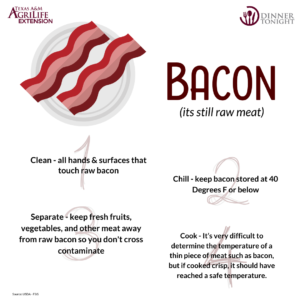
Because bacon has been cured, some of us might forget that bacon is still raw meat!! Handle it like you would any other raw meat, clean, chill, separate, and cook.

  • Clean – all hands & surfaces that touch raw bacon.
  • Separate – keep fresh fruits, vegetables, and other meat away from raw bacon so you don’t cross contaminate.
  • Chill – Keep bacon stored at 40 Degrees F or below.
  • Cook – It’s very difficult to determine the temperature of a thin piece of meat such as bacon, but if cooked crisp, it should have reached a safe temperature.

Find the full article from the USDA FSIS here.


Additional Sources:

The Washington Post

Coleman Meats

Simply Recipes

Filed Under: Food Safety Tagged With: bacon, Food Safety

Spices, Do they Expire?

September 12, 2019 by Dinner Tonight

When was the last time you looked at your spices?  Do they still have a bright color or a strong fragrance?  Are they expired?

The USDA defines spices and other foods that can be stored at room temperature as a “Shelf Stable” product that will truly never expire, however, over time the flavor and potency of the spices will diminish.  Flavoring extracts can evaporate over time.  Most of the shelf life is between 6 months to 1 year, with the exception of pure vanilla extract.  Pure vanilla extract can improve with age if stored in a dark cool place.

Try these tips to keep your spice rack on track!

-Keep spices in the original bottles or store in airtight containers.

-Add the date you purchased spice on the bottle for a quick reference.

-Read the manufactures label, most of the time there is an expiration date.

-Store in a dark cool place.

Take a look at some of the popular spices and a suggested shelf life.

Filed Under: Food Safety Tagged With: Food Safety, spice, spices

Finger Food Etiquette

June 17, 2019 by Dinner Tonight

BBQ’s, picnics, and outdoor adventures, oh my! Summer tends to keep you busy outside, hence all the delicious meals as well.  Learn the basics of finger food etiquette so you’ll be ready for all the finger-lickin’ food. Or maybe you’re headed to holiday parties for work, family, and friends! No matter the situation you might be faced with a finger food style meal, be sure to follow these tips to keep yourself and everyone else safe!

Eating foods with your fingers can be quite fun, but also tricky.  Here’s the low-down of what you need to know before picking away:

  • Always wash your hands before and after enjoying your delicious foods.
  • Always have a napkin nearby. Sometimes, utensils are not offered, so it’s nifty to use a napkin instead.
  • Some foods don’t require a utensil.  Popular items include deviled eggs, roll-ups, vegetables with dip, olives, pickles, crackers, etc. For appetizer buffets that have serving platters, its best to use the serving utensils rather than your hands to pick up food.
  • Lastly, if appetizers are served on toothpicks or skewers, pick them up by the stick.

Read our handy guide to double-dipping etiquette.

Find a list of delightful snacks and appetizers for your next party here!

See our tips on keeping your party food safe for your guests here!

Filed Under: Food Safety Tagged With: appetizers, finger food, Food Safety, picnic

Salmonella

May 28, 2019 by Dinner Tonight

Salmonella is a food borne bacteria that can cause food poisoning. Often times, it is found in poultry products including eggs. Here are some Food Safety Tips to avoid food borne illness, particularly salmonella, with eggs.

Food Safety and Eggs

Eggs can be tricky – do I buy farm fresh? do I refrigerate? pasteurized? Don’t worry Texas A&M AgriLife Extensions Dinner Tonight and Path to the Plate programs are here to help.

From purchasing to storing, eggs can be confusing. With a little bit of information, we will help you decide on how to make the best choice that fits your family.

Eggs are nutrient dense, but they also provide opportunity for food borne illnesses, such as salmonella. Be sure to take apply some of these tips to avoid food poisoning:

  • Discard Cracked Eggs | Cracked eggs are more susceptible to attracting bacteria and allowing bacteria to grow. Avoid purchasing a carton of eggs that already has a cracked egg or discard it.
  • Refrigerate at 40*F or Below | Store your eggs in the original carton at 40*F or below. Use them within 3 weeks of purchasing to ensure they are at their best quality. If you decide to freeze your eggs, use this infographic to help you on storage timeframes.
  • Cook Eggs to 160*F | Cooked egg whites and yolk should be firm.
  • Recipes with Raw Eggs Should be Kept at 40*F or Below | Dressings, hollandaise sauces, and other recipes with raw eggs in them should never reach room temperature. It’s important to keep these recipes at 40*F or cooler to avoid bacteria growth.

To learn more about food safety and eggs here’s “What You Need to Know About Egg Safety.”

Path to the Plate does a great job on explaining labels and terms:

“100% or All-Natural” – This means nothing was added to the egg (coloring, flavoring) and it does NOT indicate how the chicken was raised.

“USDA Organic” – Certified organic eggs are from uncaged hens that have free range of their houses and access to outdoor spaces. They are also fed an organic diet.

“Vitamin Enhanced” – Hens are given a special diet that helps them produce eggs with a higher vitamin content (e.g. Vitamin E).

“Omega-3 Enriched” – Hens are fed a diet that includes flaxseed, algae or fish oils to increase the Omega-3 fatty acid content of the eggs.

“No Antibiotics” – Hens are raised without any antibiotics of any type.

“No added Hormones” – NO eggs have added hormones (regardless of what the package says) because the use of hormones is NOT allowed in hog or poultry production. If you see “No added hormones” on a package, it must be followed by the statement: “Federal regulations prohibit the use of hormones”.

“Free-range” – Hens are cage free with continuous access to the outdoors during their laying cycle.

“Cage-free” – Hens are raised in an enclosed structure with unlimited access to food and water. They are NOT required to have access to the outdoors.

To learn more about Food Labels among other products, go to Path to the Plate’s Food Labels.


Sources:

https://www.fda.gov/food/buy-store-serve-safe-food/what-you-need-know-about-egg-safety

https://pathtotheplate.tamu.edu/topics/food-labels/

https://pathtotheplate.tamu.edu/4-tips-for-egg-storage-2/

Filed Under: Food Safety Tagged With: Food Safety

  • « Go to Previous Page
  • Page 1
  • Page 2
  • Page 3
  • Page 4
  • Page 5
  • Interim pages omitted …
  • Page 11
  • Go to Next Page »

Newest Recipes

  • Coconut Watermelon Zing
  • Egg Salad Veggie Wrap
  • Peanut Butter Wraps
  • Runzas
  • Al Pastor Chickpea and Cauliflower Tacos

Recipes to Try

  • Main Dishes
    • Beef Recipes
    • Chicken Recipes
    • Turkey Recipes
    • Pork Recipes
    • Seafood Recipes
    • Vegetarian Recipes
    • Salad Recipes
  • Side Dish Recipes
  • Snack Recipes
  • Dessert Recipes
  • Kid Friendly Recipes
  • All Recipes

Sign up for our newsletter to get new recipes & tips!

Sign Up Now

AgriLife Extension logo

  • Compact with Texans
  • Privacy and Security
  • Accessibility Policy
  • State Link Policy
  • Statewide Search
  • Veterans Benefits
  • Military Families
  • Risk, Fraud & Misconduct Hotline
  • Texas Homeland Security
  • Texas Veterans Portal
  • Equal Opportunity
  • Open Records/Public Information
Texas A&M University System Member