Food Safety at Potlucks
Potlucks, Tailgates, and Parties are fun, but food safety must always be a priority! Use these simple steps to keep food safe for all!
Plan Ahead
- Keep food safety in mind as you plan your potluck dish.
- When possible, bring items that do not require temperature control, such as whole fresh fruits, nuts, dried fruits, and certain types of baked goods.
- If you bring hot or cold foods, make sure that you have a way to keep hot foods hot and cold foods cold.
Preparation
- Properly wash your hands before preparing food.
- Minimize the handling of foods with bare hands. Instead, use utensils, especially when mixing cold salads that contain cooked ingredients, such as potato, ham, chicken, or pasta salads.
- For cold-mixed dishes, allow ingredients to cool before mixing them together.
- After they are mixed, cold salads must be kept cool (at 40°F or lower) at all times.
Transporting
- Keep cold food (such as cold salads with ingredients such as ham, chicken, tuna, and potatoes) at 40°F or below. Use a cooler with ice or gel packs.
- Keep hot foods (such as stews and chili) at 140°F or above. Use an insulated container, such as a crock pot wrapped in paper bags, during travel.
- Wrap casserole dishes with aluminum foil. Pack just before leaving home and open the container right before serving.
Serving
- Assign one person to be in charge of checking the food to ensure it is safe to eat.
- Keep surfaces clean and use clean dishes and utensils to serve.
- Provide plenty of utensils for each item so that people can avoid touching the food.
- Keep it Covered – Keep in mind that pests are attracted to food. Have a way to keep your food covered at the tailgate party – saran wrap, foil, or a lid.
- Hot Foods Hot, Cold Foods Cold – Using a cooler will be your best friend! Ice is your friend when keeping cold foods cold; cover your dish with several inches of ice. As for your hot foods, if you can’t keep them warm on the way to the tailgate, plan to keep them chilled on the way. Reheat to 165*F upon arrival.
- 2-Hour Rule – Don’t let perishable foods sit out for more than 2 hours (1 hour if temperatures rise above 90*F). Toss any food left out for longer.
Reheating Leftovers
Reheat leftovers to 165°F.
Serve food onto clean, small plates and do not refill them; use new clean plates.
Use long-handled utensils so that handles do not fall into the food.
Separate raw foods from cooked and ready-to-eat foods.
Keep hot foods at 140°F or warmer. Use slow cookers and warming trays. (Note: do not use this equipment to reheat the food; reheat food to 165 F on the stovetop, microwave, or oven and then place in a slow cooker or warming tray)
Keep cold foods at 40°F or colder. Place dishes in bowls of ice, or use small serving trays and replace them often.
Wash plates and utensils with hot, soapy water to minimize the risk of cross-contamination.
Use a food thermometer to check food temperatures frequently. After the party, discard any food that was left in the danger zone (40°F–140°F) for more than two hours (or more than one hour on a very hot day).
Storing Leftovers
If foods have been safely handled and have not been in the danger zone for more than two hours, the leftovers are safe to eat.
Divide leftover food into smaller portions and put it in clean, shallow, covered containers or resealable bags.
Immediately place leftovers in the refrigerator (40°F or lower) or freezer for rapid cooling.
Use cooked leftovers within 3 to 4 days.
Sources:
United States Department of Agriculture, Food Safety and Inspection Service, Safe Food Handling. Cooking for Groups. Retrieved from https://www.fsis.usda.gov/shared/PDF/Cooking_for_Groups.pdf
https://www.usda.gov/media/blog/2013/08/30/tackling-tailgate-food-safety-wins
Healthy at potlucks
Healthy Appetizers: Make it easy on yourself and healthy on others by cutting up fresh veggies and serving with a healthy dip such as hummus. Another option is fruit! Make fruit kabobs on party toothpicks or skewers. This makes them easy to pick-up, an attractive option, and a great way to increase intake of important nutrients!- Go Ahead and Get the Chips: Don’t forego the chips and guacamole, but make it a healthy option by bringing whole grain tortilla chips to go with heart healthy guacamole. Want to control portions on the guacamole? Serve it in individual soufflé cups with lids (makes it easy for transport as well).
- Do a Salad Swap: Instead of taking a green salad which may result in a high fat creamy dressing on top, choose a grain based salad such as quinoa. Add low fat veggies such as tomatoes, corn, and black beans; finish off with lime juice and chopped cilantro!
Chicken Vegetable Soup
![]()
On cool evenings, nothing is more satisfying and delicious than a bowl of hearty soup. It can also be a very healthy and economical one-pot meal that uses spare vegetables that may otherwise go to waste.
The below basic formula is for a broth-based chicken vegetable soup. Unlike baking a cake, ingredients and amounts in soup do not need to be exact. [Read more…] about Chicken Vegetable Soup
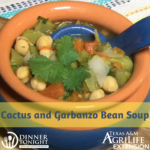
Chickpea and Cactus Soup
- 4 cactus paddles
- 1 can garbanzo beans drained, no salt added
- 2 tablespoons olive oil
- 1 clove garlic diced
- 1 1/2 tomatoes chopped
- 1/2 bell pepper
- 1 chile pepper seeded, dice
- 1/2 cup cilantro chopped
- 3 cups water
- Wash your hands, clean your cooking area, and wash vegetables.
- Peel and trim the cacti. Wash thoroughly. Cut the cacti in small squares. In a sauce pan bring about 3 cups water to a boil. Add cacti and boil for 15 minutes. Remove from heat and drain in a colander.
- Heat olive oil in a skillet. Add the onion, tomatoes, chile pepper, bell pepper, and pepper, and cilantro and saute until onions are translucent.
- Add the drained garbanzo beans, the cacti, and the chopped cilantro to the onion mixture. Add 3 cups water and simmer for 15 minutes.