• Skip to primary navigation
  • Skip to main content
  • Skip to primary sidebar
  • Skip to footer
Dinner Tonight

Dinner Tonight

Healthy Cooking for a Healthy Texas

  • Email
  • Facebook
  • Instagram
  • Pinterest
  • Twitter
  • YouTube
  • Home
  • Recipes
  • Store
  • Healthy Cooking Tips
    • How To
    • Food Safety
  • Family Mealtime
  • Meet the Team
  • Events

Freezer Success

April 6, 2020 by Dinner Tonight

Freezing foods is an easy and convenient way to store foods but a lot of people send food to the freezer, never to be used or seen again (until they get thrown away)! Make your freezer work for you with our Tips to Freezer Success.

Here are our top tips for freezer success:

  • Cool foods completely before freezing – you can refrigerate then freeze too!
  • Pack leftover in smaller containers! This makes food freeze faster and reduces the need to thaw more food than necessary
  • Label & Date your packages and containers – don’t waste food by having to throw food away because you don’t know how old it is!
  • Keep an inventory of your freezer items. Don’t forget about freezer meals!
  • Don’t pack too tight! Make sure there is room for air to flow in your freezer, this helps maintain proper and even temperatures.
  • FDA recommends your freezer be set at 0 degrees F.

Another important part is managing your freezer properly: 

  • Place your freezer in a cool, dry area where the temperature is constant.
  • Keep your freezer at least ¾ full for efficient operation.
  • Continue to use and replace foods. Do not simply store them.
  • Open the freezer door as rarely as possible.
  • Make proper use of energy saving features on your freezer.
  • Keep door seals clean and check for proper sealing. Replace when necessary.
  • Defrost manual freezers regularly.
  • Keep the condenser coils clean.

Make sure you’re packaging you goods well, good packaging material should have the following characteristics:

  • Moisture/vapor-proof or at least moisture resistant.
  • Made of food grade material, i.e. designed to be used for food products.
  • Durable and leakproof.
  • Doesn’t become brittle and crack at low temperatures.
  • Resistant to oil, grease or water.
  • Protect foods from off flavors and odors.
  • Easy to fill and seal.
  • Easy to mark and store.

Join Jocelin as she shows you the basics on freezing your food!

Click below to download a printable freezer storage chart from the FDA so you know how long that food in your freezer is good for!

Food-Safety- FreezerFridge Storage Chart

Sources:

Food Freezing Guide – North Dakota State University

FDA.gov


Filed Under: Food Safety, Tips & Tricks Tagged With: Food Safety, freezer, frozen, frozen foods, tip, tips, tips and tricks

Multifunction Cooker

March 30, 2020 by Dinner Tonight

Multifunction Cookers, common brand Instant Pot®, are a new tool that many cooks have in their kitchen! Multifunction cookers can be a great way to provide quick and nutritious meals with a “hands off” cooking approach so that you can be free to spend your time on other things. Below are some tips to help your multifunction cooker experience go smoothly and safely! You should always make sure to follow the guidance of your multifunction cooker’s user manual and read it thoroughly before beginning to cook.
About Multifunction Cookers

Pressure Release:

Natural Release (NR): No action is taken. Allow the cooker to cool naturally, release heat and pressure over time. You will know that the cooker is no longer pressurized when the float valve drops into the lid.

Note: May take 10 – 40+ minutes. Depressurization time will vary based upon volume of food and liquid.

Quick Release (QR): Turn the steam release handle from the “Sealing” position to the “Venting” position. If spatter occurs, turn steam release handle back to “Sealing” position, and try again after a few minutes. The float valve will drop into the lid when the cooker has depressurized.

Stages of Cooking:

  1. Heating & Pressurization
    The cooker will preheat, creating the steam required to build pressure. Once enough steam pressure has accumulated, the float valve will pop up and “pressurize” the cooker. During the Water Test, this may take 5 – 15 minutes.Do not press down on the lid; the float valve will rise when sufficient steam pressure has built up. Until the cooker pressurizes and the float valve has popped up, the lid will be removable. Once pressurized, the lid will lock.Note: The time it takes your cooker to pressurize is determined by a variety of factors, including food and liquid volume.It is normal to see steam exit the float valve hole until the float valve pops up and the cooker pressurizes. If you see steam escaping from around the sides of the lid, stop the test to ensure that your sealing ring is properly installed
  2. Cook Cycle
    The cooker will not start the countdown right away. First, the cooker must come to pressure. Within 5 minutes of pressurization, the cooker will beep once and the countdown will appear on the display. When the timer reaches “00:00”, the cooker will beep 10 times to signal that cooking has completed.Note: Smart Programs allow you to make changes to time, temperature, and pressure levels during the cook cycle.
  3. Depressurization & Keep Warm
    When pressure cooking has completed, follow your recipe’s directions when selecting a venting method.
    Always ensure that the float valve has dropped completely before attempting to open the lid. If the lid will not turn, do not attempt to force the lid open.
    If Keep Warm is turned ON after the cook cycle completes, the timer will count up. If Keep Warm is not turned ON, cooker will return to Standby. Note: The cooker will cool sufficiently to NR over time, but it will cool faster if Keep Warm is turned OFF

Safety with Multifunction Cookers

  1. Use a food thermometer – When food is done cooking, no matter what method, you should always use a food thermometer to ensure that meat has been cooked to the proper safe minimum internal temperature. If it has not been cooked to the minimum internal temperature then you will need to continue cooking, whether that be via the multifunction cooker or other method such as oven, stove top, grill, etc.
    1. Product Minimum Internal Temperature & Rest Time
      Beef, Pork, Veal & Lamb
      Steaks, chops, roasts
      145 °F (62.8 °C) and allow to rest for at least 3 minutes
      Ground meats 160 °F (71.1 °C)
      Ham, fresh or smoked (uncooked) 145 °F (62.8 °C) and allow to rest for at least 3 minutes
      Fully Cooked Ham
      (to reheat)
      Reheat cooked hams packaged in USDA-inspected plants to 140 °F (60 °C) and all others to 165 °F (73.9 °C).
      Product Minimum Internal Temperature
      All Poultry (breasts, whole bird, legs, thighs, wings, ground poultry, giblets, and stuffing) 165 °F (73.9 °C)
      Eggs 160 °F (71.1 °C)
      Fish & Shellfish 145 °F (62.8 °C)
      Leftovers 165 °F (73.9 °C)
      Casseroles 165 °F (73.9 °C)
  2. Placement of Multifunction Cooker – Multifunction cookers are intended for countertop use, it is recommended that you use your multifunction cooker in your kitchen on a kitchen counter. Be sure to keep cookers away from any external heat sources such as heated ovens, stove tops and gas ranges.
  3.  De-pressurizing – see above for safe de-pressurizing methods.
  4. Read the User Manual – the best way to ensure the safe operation of your multifunction cooker is to read your cooker’s user manual so that you are familiar with its functions, parts, and best practices.
  5. Initial Test – if this is your first time using your multifunction cooker, do an initial test with water to ensure that you are familiar with the process and your cooker is functioning properly.


Check out our recipe for cooking a whole chicken in your multifunction cooker! 

Sources:

Instant Pot® Initial Test Run

Instant Pot® 10 Common Newbie Mistakes

Safe Minimum Internal Temperatures

Disclaimer: Dinner Tonight and/or Texas A&M AgriLife Extension Service does not promote or support purchasing a single brand, such as the Instant Pot ®. 

Filed Under: Food Safety, How to videos

DIY Bleach Solutions

March 18, 2020 by Dinner Tonight

Stay safe out there! Safely clean frequently touched surfaces with this homemade bleach solution recommended by the Centers for Disease Control.

Diluted household bleach solutions can be used if appropriate for the surface. Follow manufacturer’s instructions for application and proper ventilation. Check to ensure the product is not past its expiration date. Never mix household bleach with ammonia or any other cleanser. Unexpired household bleach will be effective against coronaviruses when properly diluted.

  • Prepare a bleach solution by mixing:
      • 5 tablespoons (1/3rd cup) bleach per gallon of water or
      • 4 teaspoons bleach per quart of water

Filed Under: Food Safety, How to videos, Tips & Tricks

Bacon

January 30, 2020 by Dinner Tonight

Cured or Uncured Bacon… Which is right for me and my family?

Let’s dive into what cured and uncured bacon means on the commercial food labels and packaging. In reality all bacon has some type of curing to preserve the meat to keep it fresh and appetizing. The food packaging indicates what type of ingredients were used to preserve the meat.

  • Cured (as labeled on packaging) – Uses chemical compounds like nitrates and nitrites to preserve the meat and give it a pink color.
  • Uncured (as labeled on packaging) – Uses natural ingredients like celery powder and sea salt to preserve the meat. The USDA requires uncured bacon to be labeled as such.

Here are some other things to consider when shopping for cured or uncured bacon.

  • Taste – Cured and uncured bacon usually taste the same, unless the brine includes additional flavorings. 
  • Salt content – Uncured bacon can be saltier than cured bacon because it sits in brine longer during curing. Low sodium bacon is more common these days, if you’re looking to reduce sodium intake, look for low sodium bacon. 
  • Health – While nitrates occur naturally in the body and plants, too many can be harmful.

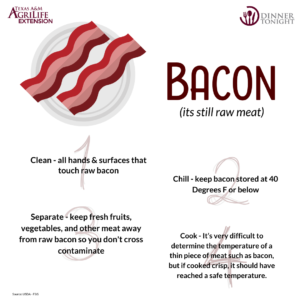
Because bacon has been cured, some of us might forget that bacon is still raw meat!! Handle it like you would any other raw meat, clean, chill, separate, and cook.

  • Clean – all hands & surfaces that touch raw bacon.
  • Separate – keep fresh fruits, vegetables, and other meat away from raw bacon so you don’t cross contaminate.
  • Chill – Keep bacon stored at 40 Degrees F or below.
  • Cook – It’s very difficult to determine the temperature of a thin piece of meat such as bacon, but if cooked crisp, it should have reached a safe temperature.

Find the full article from the USDA FSIS here.


Additional Sources:

The Washington Post

Coleman Meats

Simply Recipes

Filed Under: Food Safety Tagged With: bacon, Food Safety

Potatoes

November 12, 2019 by Dinner Tonight

Smart Starch Food Safety

Potatoes are among some of the most common leftover food items, especially during the holiday season. Be sure you’re storing and reheating all of your leftovers safely before reserving them to friends and family. For more information on why potatoes pose a food safety concern and how to properly handle them.

According to the 2017 Potato Statistical Yearbook created by the National Potato Council, 44 billion pounds of potatoes were produced in the U.S. in 2015. Some of those were turned into potato chips, others french fries. Many potatoes were baked or boiled and then served in restaurants, catering, healthcare, and other foodservice operations. And surprisingly, cooked potatoes pose a food safety risk, because they are considered a Time/Temperature Control for Safety (TCS) food. Looking for tips on peeling your potatoes? Check out this tip. 

Time/Temperature Control for Safety refresher (TCS food). 

TCS foods, like cooked potatoes, are prone to bacteria growth because they are moist, contain protein, and have a neutral or slightly acidic pH. This is ideal for the growth of microorganisms and the production of toxins. Proper cooking, holding times, and cooling techniques are imperative to avoiding time-temperature abuse and keeping TCS foods safe.

Why are cooked potatoes considered TCS food?

If cooked potatoes are not cooled properly, they can easily enter the temperature danger zone. Additionally, cooled potatoes are often combined with mayonnaise or oil to make potato salads, which makes them even more of a breeding ground for bacteria like salmonella or listeria when proper temperatures aren’t maintained.

3 ways to prevent potato-related food hazards

1. Cool off. Cooling potatoes properly is the best way to avoid a foodborne illness outbreak. Cooling potatoes in the refrigerator takes a minimum of 4 hours, but it can be expedited with these methods:

  • Ice-water bath.
  • Ice paddle.
  • Blast or tumble chiller.
  • Divide large batches of potatoes into shallow pans and spread them out.

2. Serve safely. If cooked potatoes are being reheated, make sure they reach at least 165°F. If the potatoes are being used in a ready-to-eat cold dish, like a potato salad, make sure the dish is served below 41°F. Tip: Place clean ice packs in or around the dish or use an ice-water bath to keep things safely cool.

3. If in doubt, throw it out! Any food that has been in the temperature danger zone of 41-135°F for more than 4 hours should be discarded. If you aren’t sure how long potatoes have been at 41-135°F, it is better to toss them than risk serving them to your customers, friends, or family.

Check out our source. 

Nutritional Value of Potatoes

Sometimes potatoes can have a bad rap but, in fact, potatoes contain a variety of beneficial nutrients! Check out a few of these nutritional benefits below!

  • Carbohydrates
  • Fiber
  • Potassium
  • Vitamin C
  • Vitamin B6
  • Manganese

Potatoes can be prepared in many ways but is there one type of potato that’s suitable for all of your cooking techniques? Find out what type of potatoes you should be using here.

The Difference Between Starchy vs. Waxy Potatoes

Russet potatoes are called starchy because they contain more of a certain kind of starch that makes them cook up drier and fluffier. That’s why they’re ideal for soaking up butter and gravy when they’re baked or mashed. But that same fluffy texture makes them fall apart in stews.

Boiling potatoes and fingerlings are called waxy because they hold their shape when they’re cooked. Firm rather than fluffy, their texture can stand up to the moisture in soups and casseroles without disintegrating.

All-purpose potatoes are like the Goldilocks of the potato world. Their balance of starchiness and waxiness makes them just right for almost any recipe.

Find the Original Article Here. 

Find your next potato recipe:

  • Air Fryer Baby Potatoes
  • Baked Potato Soup
  • Chicken and Gnocchi Dumplings
  • Creamy Potato Salad
  • Garlic Mashed Potatoes
  • Leek and Potato Frittata
  • Pepperoni Frittata
  • Potatoes
  • Roasted Fries
  • Sautéed Vegetable and Potato Hash
  • Slowcooker Baked Potatoes
  • Southwest Egg Muffins
  • Stuffed Baked Potatoes
  • Sweet Potato Casserole
  • Veggie Tots

Filed Under: Food Safety, Tips & Tricks Tagged With: potato, tip, tips and tricks

  • « Go to Previous Page
  • Page 1
  • Page 2
  • Page 3
  • Page 4
  • Page 5
  • Interim pages omitted …
  • Page 15
  • Go to Next Page »

Newest Recipes

  • Dill Pickle Chicken Salad
  • Smokey Chicken, Black Bean, Sweet Potato Burrito
  • Buffalo Chicken Sweet Potato
  • Green Tea Lemonade
  • Paradise Pops

Recipes to Try

  • Main Dishes
    • Beef Recipes
    • Chicken Recipes
    • Turkey Recipes
    • Pork Recipes
    • Seafood Recipes
    • Vegetarian Recipes
    • Salad Recipes
  • Side Dish Recipes
  • Snack Recipes
  • Dessert Recipes
  • Kid Friendly Recipes
  • All Recipes

Sign up for our newsletter to get new recipes & tips!

Sign Up Now

AgriLife Extension logo

  • Compact with Texans
  • Privacy and Security
  • Accessibility Policy
  • State Link Policy
  • Statewide Search
  • Veterans Benefits
  • Military Families
  • Risk, Fraud & Misconduct Hotline
  • Texas Homeland Security
  • Texas Veterans Portal
  • Equal Opportunity
  • Open Records/Public Information
Texas A&M University System Member